Be on High Alert for Spotted Lanternfly
Be on the Lookout!
(Updated: Nov. 7, 2021, 11:01 a.m.)
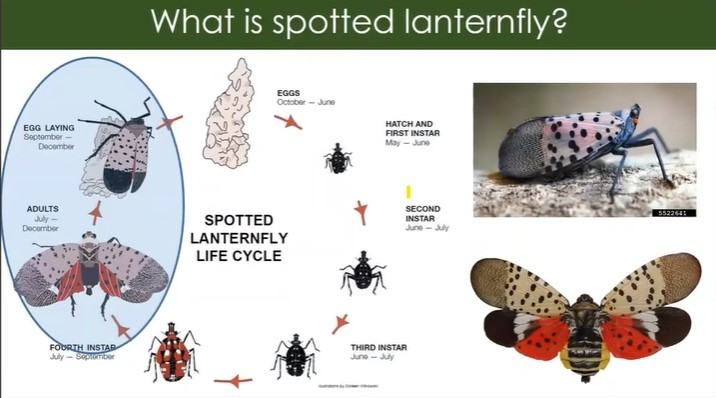
Alarmingly, the N.C. Department of Agriculture and Consumer Services received notice from the Virginia Department of Agriculture that Spotted Lanternfly (SLF) now has an established population in Carroll County, just north of Surry County, North Carolina. We are ramping up survey and outreach efforts in that area, however, any vehicle, camper, and commodity moving from any SLF-infested area could move the highly invasive pest to our state. We believe the highest risk areas in North Carolina are locations with camping, tourist attractions, conventions, or other visitor attractions, but we cannot rule out even a single vehicle that stops in our state for gas could carry a gravid female or viable egg mass. Most recently we learned that SLF can even move on the exterior of aircraft and the insect may not require Tree-of-Heaven to complete its lifecycle. SLF feeds on more than 70 plants and although vineyards are at the greatest agricultural risk, home values, tourism, and outdoor venues are just a few industries that take a financial hit in areas where SLF is established.
Other SLF-infested areas in Virginia include Prince William, Shenandoah, Page counties, the cities of Lynchburg and Winchester, and the quarantined Frederick, Clarke, and Warren counties. Additional states with established Spotted Lanternfly populations include Connecticut, Massachusetts, New York, Pennsylvania, New Jersey, Maryland, Delaware, Indiana, Ohio, and West Virginia. New infestations are being found regularly so adjacent states to those listed above could potentially carry Spotted Lanternfly as well.
Our Newest Tools
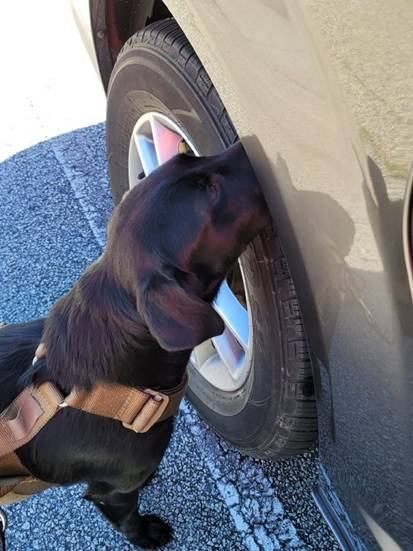
NCDA&CS – Plant Industry Division is excited to add two new SLF team members to our staff in less than a week. Kita and Neeko are USDA-trained SLF detector dogs that will be used to find SLF egg masses in an array of challenging situations. Kita’s Handler is Jackie Fredieu, Entomology Program Specialist and the pair will be stationed in Raleigh and Neeko’s handler is Chad Taylor, Western Region Field Supervisor who is based in Boone. Kita and Neeko will be deployed daily to survey high-risk sites across the state and will be critical in our follow-up investigations of SLF reports.