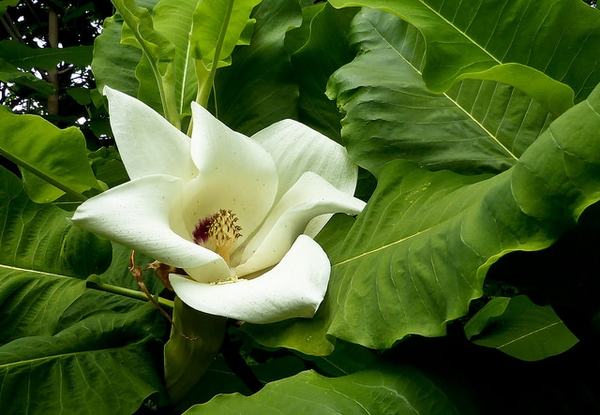
My favorite native tree is the Bigleaf magnolia. Sometimes known as the 'newspaper tree', the huge leaves of Magnolia macrophylla, can be as big as 30 inches long. When they collect on the ground in the fall, it looks as if someone spread newspapers under the tree.
Bigleaf magnolias can be large trees. Although you rarely see big mature ones, these trees can reach over 100 feet tall. The National Champion is in Kentucky and stands 108 feet tall and 42 feet across. Heights of 30-40 feet are more typical.
Native across the southeast, the tree is relegated to small pockets here and there in the Appalachian foothills and Piedmont. The distance between individuals reduces pollination rates and seed set. Due to this fact and over-collection in the wild, the tree is declining across its range. Although originally documented in 1795, just west of Charlotte, NC by the famed plant explorer Andre Michaux, the tree is listed as threatened in North Carolina.
While all magnolia flowers are spectacular, the Bigleaf magnolia's flowers are stupendous! The creamy white flowers can stretch up to 12 inches across. After the flowers fade, the typical hand grenade-shaped, pink colored fruits develop.