


Clethra, a Sweet Native Shrub
go.ncsu.edu/readext?234325
en Español / em Português
El inglés es el idioma de control de esta página. En la medida en que haya algún conflicto entre la traducción al inglés y la traducción, el inglés prevalece.
Al hacer clic en el enlace de traducción se activa un servicio de traducción gratuito para convertir la página al español. Al igual que con cualquier traducción por Internet, la conversión no es sensible al contexto y puede que no traduzca el texto en su significado original. NC State Extension no garantiza la exactitud del texto traducido. Por favor, tenga en cuenta que algunas aplicaciones y/o servicios pueden no funcionar como se espera cuando se traducen.
Português
Inglês é o idioma de controle desta página. Na medida que haja algum conflito entre o texto original em Inglês e a tradução, o Inglês prevalece.
Ao clicar no link de tradução, um serviço gratuito de tradução será ativado para converter a página para o Português. Como em qualquer tradução pela internet, a conversão não é sensivel ao contexto e pode não ocorrer a tradução para o significado orginal. O serviço de Extensão da Carolina do Norte (NC State Extension) não garante a exatidão do texto traduzido. Por favor, observe que algumas funções ou serviços podem não funcionar como esperado após a tradução.
English
English is the controlling language of this page. To the extent there is any conflict between the English text and the translation, English controls.
Clicking on the translation link activates a free translation service to convert the page to Spanish. As with any Internet translation, the conversion is not context-sensitive and may not translate the text to its original meaning. NC State Extension does not guarantee the accuracy of the translated text. Please note that some applications and/or services may not function as expected when translated.
Collapse ▲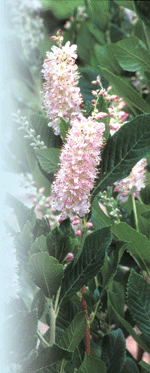
‘Rosea’
Robert E. Lyons©
Summersweet clethra, Clethra alnifolia, also known as coastal sweet pepperbush, grows naturally along streams in the eastern United States from Maine to Florida. This upright deciduous shrub has fragrant white flowers arranged in showy 3- to 5-inch racemes. It blooms in July and august, providing beauty to the late summer garden as well as food for bees and butterflies. The fruit, though not showy, is eaten by birds.
Clethra is a good plant for shady wet sites where it can grow to 8 feet tall and 6 feet wide. It forms a multi-stemmed shrub or even a colony. In partial shade or full sun it has dense, glossy green foliage that can turn yellow in mid-October. It likes acid soil and tolerates salt spray, but is not a plant for dry sites. Spider mites and dieback can be a problem in dry sites. When planted in the proper site it is insect and disease resistant.
‘Sixteen Candles’ is the top seller, though ‘Hummingbird’ is the best know cultivar. They are compact shrubs with white flowers. ‘Rosea,’ ‘Pink Spires’ and ‘Ruby Spice’ are three pink-flowered cultivars. ‘Ruby Spice’ is the darkest pink. This pink color holds even in the coastal plains. ‘Sherry Sue’ is a relatively new introduction, sporting white flowers and bright red stems. Look for most of these cultivars in the collections of the JC Raulston Arboretum (JCRA). Additionally, ‘September Beauty,’ noteworthy for flowering later in the season, can be found in the JCRA mixed border.
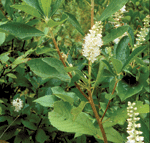
Sweet Pepperbush
Robert E. Lyons©
Another interesting species, Clethra tomentosa, showing pubescent foliage and very long racemes, also graces the Arboretum collections. Currently missing from the Arboretum collections, but worthy of inclusion in the landscape, is Japanese pepperbush, Clethra barbinervis, exhibiting beautiful cinnamon-colored exfoliating bark as it matures. Use clethra for summer flowers in wet, shady areas, particularly where the fragrance can be appreciated. Learn more at jcra.ncsu.edu.
David Goforth