


Deciduous Azaleas Dazzle With Color
go.ncsu.edu/readext?236357
en Español / em Português
El inglés es el idioma de control de esta página. En la medida en que haya algún conflicto entre la traducción al inglés y la traducción, el inglés prevalece.
Al hacer clic en el enlace de traducción se activa un servicio de traducción gratuito para convertir la página al español. Al igual que con cualquier traducción por Internet, la conversión no es sensible al contexto y puede que no traduzca el texto en su significado original. NC State Extension no garantiza la exactitud del texto traducido. Por favor, tenga en cuenta que algunas aplicaciones y/o servicios pueden no funcionar como se espera cuando se traducen.
Português
Inglês é o idioma de controle desta página. Na medida que haja algum conflito entre o texto original em Inglês e a tradução, o Inglês prevalece.
Ao clicar no link de tradução, um serviço gratuito de tradução será ativado para converter a página para o Português. Como em qualquer tradução pela internet, a conversão não é sensivel ao contexto e pode não ocorrer a tradução para o significado orginal. O serviço de Extensão da Carolina do Norte (NC State Extension) não garante a exatidão do texto traduzido. Por favor, observe que algumas funções ou serviços podem não funcionar como esperado após a tradução.
English
English is the controlling language of this page. To the extent there is any conflict between the English text and the translation, English controls.
Clicking on the translation link activates a free translation service to convert the page to Spanish. As with any Internet translation, the conversion is not context-sensitive and may not translate the text to its original meaning. NC State Extension does not guarantee the accuracy of the translated text. Please note that some applications and/or services may not function as expected when translated.
Collapse ▲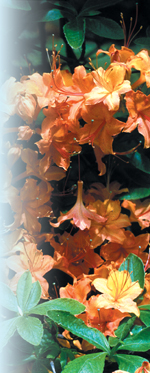
Deciduous azaleas may not compete with their evergreen relatives in popularity, but they definitely have their place, especially in naturalized landscapes. Such landscapes take advantage of existing native plants, especially large trees, often incorporating them all into a mulched area which reduces the need for mowing. Deciduous azaleas can add to these settings by providing impact with their flowers without detracting from the natural look. Deciduous azaleas, which botanically are in the genus Rhododendron, generally do well in the typical azalea conditions of filtered shade and acidic, well-drained soil with a high organic matter content.
Unlike evergreen azaleas, some of their deciduous cousins can be found growing wild in the southeastern U.S. One of the showiest species is the flame azalea, Rhododendron calendulaceum. This species and other native azaleas in the mountains are sometimes called honeysuckle. The flowers are frequently a bright orange although they may range into yellow or red. One of the most widely distributed species is Rhododendron periclymenoides (formerly Rhododendron nudiflorum), sometimes called the pinxterbloom azalea. It features pink flowers and, like the flame azalea, blooms in the spring. The plumleaf azalea, Rhododendron prunifolium, is different in that its orange to orange-red blooms arrive in the summer.
Although many hybrid cultivars of deciduous azaleas have been developed, some are not heat tolerant. Good choices are species that are native to your part of North Carolina or named cultivars which may have been developed using these species. The hybrid rhododendron collection at the JC Raulston Arboretum (JCRA) at NC State University is extensive and will provide many ideas for your garden. Look for ‘Early Red Flame’, a cultivar of the flame azalea, on the east side of the JCRA. Learn more at jcra.ncsu.edu.
Kevin Starr