


Hydrangeas – Hallmarks of the Southern Garden
go.ncsu.edu/readext?234331
en Español / em Português
El inglés es el idioma de control de esta página. En la medida en que haya algún conflicto entre la traducción al inglés y la traducción, el inglés prevalece.
Al hacer clic en el enlace de traducción se activa un servicio de traducción gratuito para convertir la página al español. Al igual que con cualquier traducción por Internet, la conversión no es sensible al contexto y puede que no traduzca el texto en su significado original. NC State Extension no garantiza la exactitud del texto traducido. Por favor, tenga en cuenta que algunas aplicaciones y/o servicios pueden no funcionar como se espera cuando se traducen.
Português
Inglês é o idioma de controle desta página. Na medida que haja algum conflito entre o texto original em Inglês e a tradução, o Inglês prevalece.
Ao clicar no link de tradução, um serviço gratuito de tradução será ativado para converter a página para o Português. Como em qualquer tradução pela internet, a conversão não é sensivel ao contexto e pode não ocorrer a tradução para o significado orginal. O serviço de Extensão da Carolina do Norte (NC State Extension) não garante a exatidão do texto traduzido. Por favor, observe que algumas funções ou serviços podem não funcionar como esperado após a tradução.
English
English is the controlling language of this page. To the extent there is any conflict between the English text and the translation, English controls.
Clicking on the translation link activates a free translation service to convert the page to Spanish. As with any Internet translation, the conversion is not context-sensitive and may not translate the text to its original meaning. NC State Extension does not guarantee the accuracy of the translated text. Please note that some applications and/or services may not function as expected when translated.
Collapse ▲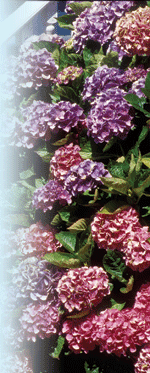
Hydrangea macrophylla
Robert E. Lyons©
Hydrangeas have always been an old favorite and are even more popular with the newer hybrids. There are more than 100 different varieties, including the climbing hydrangea, dwarf container plants, large oak-leafed varieties, red-stemmed choices and hydrangeas with pure white blooms. There are too many cultivars to list, but hydrangeas are usually placed in three basic categories: Hydrangea macrophylla, also called bigleaf, mop head or French hydrangea; Hydrangea quercifolia, oakleaf hydrangea; and Hydrangea paniculata, often referred to as PeeGee hydrangea.
The most popular hydrangea is the big-leaf hydrangea, Hydrangea macrophylla. This is an older cultivar, usually pink or blue, depending on soil pH. Soil pH affects available aluminum uptake responsible for color change. However, a few white cultivars are available. Acidic soils produce blue flowers and alkaline soils produce pink petals. Newer cultivars such as ‘Endless Summer’ and ‘Blushing Bride’ are touted as ever-blooming plants. When planting, locate big-leaved hydrangeas in a semi-shaded spot where the soil is moist and drains well.
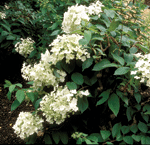
Hydrangea paniculata ‘White Moth’
Robert E. Lyons©
Oakleaf hydrangea, Hydrangea quercifolia, is a dramatic, white-blooming shrub with four seasons of interest that include fall foliage color, leaf texture and bark interest. It thrives in much drier locations than its cousins.
Hydrangea paniculata types boast blooms that are usually panicle-shaped (somewhat cone-shaped) rather than bell-shaped. Often, in late summer, the blooms develop a pink shade as the blooms age, extending their beauty into the fall. PeeGees are desirable because they tolerate pruning well. Prune at any time except when they begin forming bloom heads in the summer. PeeGees often get very large, with some the size of small trees in the mountains. However, compact forms for smaller spaces are appearing in nurseries.