


Japanese Iris — a Popular Perennial for Boggy Sites
go.ncsu.edu/readext?235953
en Español / em Português
El inglés es el idioma de control de esta página. En la medida en que haya algún conflicto entre la traducción al inglés y la traducción, el inglés prevalece.
Al hacer clic en el enlace de traducción se activa un servicio de traducción gratuito para convertir la página al español. Al igual que con cualquier traducción por Internet, la conversión no es sensible al contexto y puede que no traduzca el texto en su significado original. NC State Extension no garantiza la exactitud del texto traducido. Por favor, tenga en cuenta que algunas aplicaciones y/o servicios pueden no funcionar como se espera cuando se traducen.
Português
Inglês é o idioma de controle desta página. Na medida que haja algum conflito entre o texto original em Inglês e a tradução, o Inglês prevalece.
Ao clicar no link de tradução, um serviço gratuito de tradução será ativado para converter a página para o Português. Como em qualquer tradução pela internet, a conversão não é sensivel ao contexto e pode não ocorrer a tradução para o significado orginal. O serviço de Extensão da Carolina do Norte (NC State Extension) não garante a exatidão do texto traduzido. Por favor, observe que algumas funções ou serviços podem não funcionar como esperado após a tradução.
English
English is the controlling language of this page. To the extent there is any conflict between the English text and the translation, English controls.
Clicking on the translation link activates a free translation service to convert the page to Spanish. As with any Internet translation, the conversion is not context-sensitive and may not translate the text to its original meaning. NC State Extension does not guarantee the accuracy of the translated text. Please note that some applications and/or services may not function as expected when translated.
Collapse ▲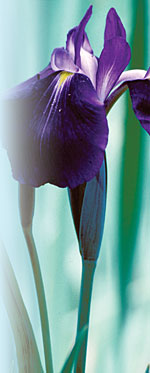
I. ensata
Robert E. Lyons ©
A popular perennial for wet and boggy sites is the Japanese iris, Iris ensata. This beauty with spectacular flowers and sword-shaped foliage provides the exclamation point in late spring and early summer gardens. Iris ensata, formerly known as I. kaempferi, blooms later than the bearded iris hybrids, with huge 8- to 10-inch-wide flat blossoms, often mottled or delicately patterned in shades of white, violet, blue or purple. The flowers are exquisite but fragile and easily damaged by hot sun, dry wind or heavy rains. Japanese irises are excellent for the damp banks of a pond or stream or in rain gardens. They also grow in a rich, moist, fertile bed that has been generously amended with organic matter, particularly when acidic in nature. Combined with masses of Japanese primroses, they make any garden site quite lovely.
Hundreds of cultivars are available in many color combinations. Most have very small standards (the small projecting petal-like structure near the flower’s center) and wide, flat falls (the three very colorful droopy structures); some are double with a soft mass of petals. I. laevigata, a close cousin, also has spectacular large flowers in shades of white or purple. It needs constant moisture around the roots and does best in shallow water.
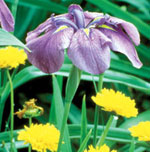
I. ensata
Robert E. Lyons ©
Plant Japanese irises in early fall, setting the rhizomes about 2 inches deep and 12 to 18 inches apart. Divide every 3 to 4 years, if desired, but it is not necessary to the overall good health of the plant. Remove faded flowers if desired.
Another desirable feature of Japanese irises is their relative resistance to the iris borer, a damaging pest that can lead to soft, dead rhizomes in bearded iris,Iris x germanica. They do not grow as fast as related species that are popular in home gardens, and they may respond adversely to minor changes in their surrounding growing conditions, like reduced sun, drier soils and loss of acidity.
Japanese irises are not found extensively throughout the JC Raulston Arboretum (JCRA) but they contribute to the overall palette of all Iris species that can be enjoyed through the year at the JCRA.
Willie Earl Wilson