


Rosemary Provides Landscape Variety, Culinary Delight
go.ncsu.edu/readext?236074
en Español / em Português
El inglés es el idioma de control de esta página. En la medida en que haya algún conflicto entre la traducción al inglés y la traducción, el inglés prevalece.
Al hacer clic en el enlace de traducción se activa un servicio de traducción gratuito para convertir la página al español. Al igual que con cualquier traducción por Internet, la conversión no es sensible al contexto y puede que no traduzca el texto en su significado original. NC State Extension no garantiza la exactitud del texto traducido. Por favor, tenga en cuenta que algunas aplicaciones y/o servicios pueden no funcionar como se espera cuando se traducen.
Português
Inglês é o idioma de controle desta página. Na medida que haja algum conflito entre o texto original em Inglês e a tradução, o Inglês prevalece.
Ao clicar no link de tradução, um serviço gratuito de tradução será ativado para converter a página para o Português. Como em qualquer tradução pela internet, a conversão não é sensivel ao contexto e pode não ocorrer a tradução para o significado orginal. O serviço de Extensão da Carolina do Norte (NC State Extension) não garante a exatidão do texto traduzido. Por favor, observe que algumas funções ou serviços podem não funcionar como esperado após a tradução.
English
English is the controlling language of this page. To the extent there is any conflict between the English text and the translation, English controls.
Clicking on the translation link activates a free translation service to convert the page to Spanish. As with any Internet translation, the conversion is not context-sensitive and may not translate the text to its original meaning. NC State Extension does not guarantee the accuracy of the translated text. Please note that some applications and/or services may not function as expected when translated.
Collapse ▲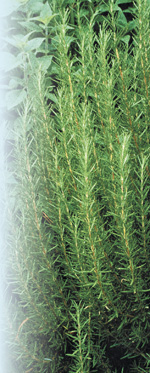
Rosemary
Photo by Robert E. Lyons
Rosemary, Rosmarinus officinalis, is an attractive, drought-tolerant perennial that should be part of everyone’s landscape or herb garden. Steeped in thousands of years of myth and tradition, and known as the herb of love and remembrance, rosemary delih1ghts both beginners and seasoned gardeners.
Many varieties exist, with some hardy to -10 degrees F as long as they have some time to slowly harden off in the fall. Classified as either upright or creeping, some varieties grow tall and upright, others low and bushy. The upright varieties make a good, informal hedge. Prostrate varieties look best in pots or cascading over masonry or rock walls or in rock gardens where the individual branches create interesting edge patterns. These also can be shaped by selective pruning. All varieties are evergreen and most will bear tiny white or blue flowers intermittently, making it a decorative shrub. Put this together with its value as an herb and this plant is a winner.
Native to coastal regions of the Mediterranean and North Africa, the Latin name Rosmarinus means dew of the sea, a reference to the shimmering blue flowers that cover the plant. Like most Mediterranean plants, it needs good drainage and a hot, sunny site.
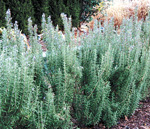
‘Tuscan Blue’
Photo by Robert E. Lyons
Popular rosemary cultivars that grow upright include ‘Gorizia’, ‘Tuscan Blue’, ‘Salem’, and ‘Arp’. ‘Gorizia’ has leaves that are double the size of more ordinary varieties. Mature plants may grow to 5 feet tall and wide. ‘Tuscan Blue’ has strong, upright thick stems and can reach heights of 7 feet or more. ‘Salem’ grows to 4 or 5 feet with dark blue flowers reminiscent of common rosemary. ‘Arp’ is referred to as the winter hardy variety and grows to about 5 feet. For the best-looking prostrate rosemary, consider ‘Blue Boy’.
One of the best places to sample rosemary with your eyes and nose is the Paradise Garden in the JC Raulston Arboretum. A soldier row presentation of these plants, rigid in formation, is protecting the fort, situated along the west border of the Paradise Garden. Learn more at https://jcra.ncsu.edu/.