


Hardy Palms Create a Tropical Feel
go.ncsu.edu/readext?232809
en Español / em Português
El inglés es el idioma de control de esta página. En la medida en que haya algún conflicto entre la traducción al inglés y la traducción, el inglés prevalece.
Al hacer clic en el enlace de traducción se activa un servicio de traducción gratuito para convertir la página al español. Al igual que con cualquier traducción por Internet, la conversión no es sensible al contexto y puede que no traduzca el texto en su significado original. NC State Extension no garantiza la exactitud del texto traducido. Por favor, tenga en cuenta que algunas aplicaciones y/o servicios pueden no funcionar como se espera cuando se traducen.
Português
Inglês é o idioma de controle desta página. Na medida que haja algum conflito entre o texto original em Inglês e a tradução, o Inglês prevalece.
Ao clicar no link de tradução, um serviço gratuito de tradução será ativado para converter a página para o Português. Como em qualquer tradução pela internet, a conversão não é sensivel ao contexto e pode não ocorrer a tradução para o significado orginal. O serviço de Extensão da Carolina do Norte (NC State Extension) não garante a exatidão do texto traduzido. Por favor, observe que algumas funções ou serviços podem não funcionar como esperado após a tradução.
English
English is the controlling language of this page. To the extent there is any conflict between the English text and the translation, English controls.
Clicking on the translation link activates a free translation service to convert the page to Spanish. As with any Internet translation, the conversion is not context-sensitive and may not translate the text to its original meaning. NC State Extension does not guarantee the accuracy of the translated text. Please note that some applications and/or services may not function as expected when translated.
Collapse ▲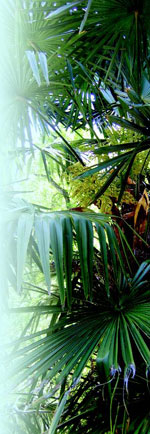
Trachycarpus fortunei
JC Raulston Arboretum ©
When people think of palm trees, they envision tropical beaches and sultry climates laden with towering plants. There are some palms that grow quite well in North Carolina’s coastal plain and piedmont. With a little effort, you may just be able to grow a few palms of your own.
The windmill palm, Trachycarpus fortunei, which is native to the Himalayan region, has a reputation for being one of the world’s hardiest palms. It has an amazing ability to survive, even when completely defoliated. It grows to about 40 feet tall and develops a solitary trunk covered with matted fiber. The palmate leaves of the windmill palm can grow to 4 feet wide and are deeply divided with drooping tips. It should be planted on a well-drained site that is protected from winds. It performs best when planted in partial shade as an understory plant or where it receives afternoon shade. It is not hardy in North Carolina’s mountains. The JC Raulston Arboretum has several cultivars of Trachycarpus fortunei, including ‘Bulgaria,’ ‘Norfolk,’ and ‘Taylor’s Hardy’ on display in Raleigh.
Another hardy palm native to the Himalayas is very new to the landscape trade and quite difficult to find: the windamere palm, Trachycarpus latisectus. This palm grows fast once it develops a trunk and can attain heights of 40 feet with a trunk diameter of 6 inches to 1 foot. The light-gray trunk shows faint rings. This palm has large, leathery leaves with very wide leaflets.
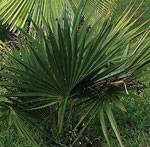
Sabel minor
Antonie van den Bos ©
Our own native dwarf palmetto palm, Sabal minor, is easier to find at local nurseries. This evergreen palm has a slow growth rate and reaches 10 feet tall at maturity. It prefers light shade and moist to wet soil, but tolerates considerable drought. Sabal minor produces small white flowers on large branched clusters in summer. Sabal ‘Birmingham,’ commonly accepted to be a hybrid of Sabal minor, makes a nice show in the landscape as well.
No matter what your travel schedule looks like, by including a couple of hardy palms in the landscape, you can have that tropical feel year-round.