


Pink Muhly Grass Prized for Ornamental Display
go.ncsu.edu/readext?235976
en Español / em Português
El inglés es el idioma de control de esta página. En la medida en que haya algún conflicto entre la traducción al inglés y la traducción, el inglés prevalece.
Al hacer clic en el enlace de traducción se activa un servicio de traducción gratuito para convertir la página al español. Al igual que con cualquier traducción por Internet, la conversión no es sensible al contexto y puede que no traduzca el texto en su significado original. NC State Extension no garantiza la exactitud del texto traducido. Por favor, tenga en cuenta que algunas aplicaciones y/o servicios pueden no funcionar como se espera cuando se traducen.
Português
Inglês é o idioma de controle desta página. Na medida que haja algum conflito entre o texto original em Inglês e a tradução, o Inglês prevalece.
Ao clicar no link de tradução, um serviço gratuito de tradução será ativado para converter a página para o Português. Como em qualquer tradução pela internet, a conversão não é sensivel ao contexto e pode não ocorrer a tradução para o significado orginal. O serviço de Extensão da Carolina do Norte (NC State Extension) não garante a exatidão do texto traduzido. Por favor, observe que algumas funções ou serviços podem não funcionar como esperado após a tradução.
English
English is the controlling language of this page. To the extent there is any conflict between the English text and the translation, English controls.
Clicking on the translation link activates a free translation service to convert the page to Spanish. As with any Internet translation, the conversion is not context-sensitive and may not translate the text to its original meaning. NC State Extension does not guarantee the accuracy of the translated text. Please note that some applications and/or services may not function as expected when translated.
Collapse ▲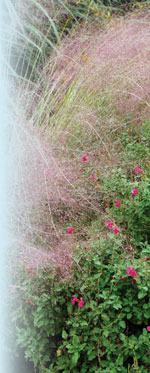
Muhlenbergia capillaris
Robert E. Lyons ©
Considered by many to be one of the most beautiful ornamental grasses, Muhlenbergia capillaris, or pink muhly grass, as it is commonly known in North Carolina, is prized for the fall show it creates. With flowers that look like a purple cloud from afar, this knee-high grass is a native that occurs in eastern North America from Kansas to Massachusetts and south to Florida and Texas.
Given this wide range of adaptation, pink muhly grass thrives in many environments, from wet prairies and dry savannas, at the outer edges of marshes, to well-drained upland pine forests. It performs best in full sun. Once established, a dense stand is remarkable in the late summer and fall when the silky, wispy, purplish-pink panicles of bloom appear almost overnight. Each panicle is 12 to 18 inches long, and up to 10 inches wide, standing tall above the wiry leaves. The color persists for 6 to 8 weeks, or until frost, when the ripe seeds that follow give an attractive tan color to the wispy plumes.
The most striking way to plant muhly grass is in clumps. Each plant consists of wire-like stems that originate from a basal clump and will get up to 3 feet tall and just as wide. Plant muhly grass in borders and perennial gardens where a fine-textured foliage is desired to accent bolder specimens. It makes an excellent groundcover for areas with poor soils, or use as a refined specimen grass in natural gardens. It is easy to start from seed and easily can be divided to start new plants. Unlike some of the non-native ornamental grasses, muhly grass will not displace other native plants and grasses. Leave the plant in the garden over the winter for interest and cut it back to around 6 to 8 inches before new growth in the spring.
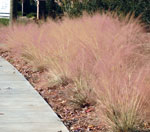
Muhlenbergia capillaris
Robert E. Lyons ©
The prominence of muhly grass at the JC Raulston Arboretum lies squarely in the striking perennial border. From a distance, this grass complements surrounding plants. Up close, its fine texture and bold mass can really be appreciated when in full flower.
Royce Hardin